
"[C]orrupt Thomism...Suárez strays from Aquinas are too many and significant to ignore. To name a few: (i) On metaphysics, Suárez blurred the distinction between essence and existence in created beings, which would eventually turn him into a favorite of contemporary ontology theorists like Martin Heidegger; (ii) On free will and pre-destination...advanced “congruism,” ...notion of human freedom, eerily similar to that of political liberalism; and (iii) On legal theory, Suárez seemed to argue that law resides in God’s will rather than reason, thus opening the door to voluntarism and perhaps totalitarianism"

https://thenewdigest.substack.com/p/the-uses-of-suarez


The Uses of Suarez

A Review of Kincaid, “Law From Below: How The Thought of Francisco Suárez, SJ, Can Renew Contemporary Legal Engagement”
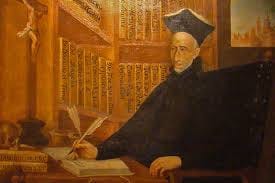
The New Digest is delighted to present this guest essay by Mr. Aníbal Sabater, a partner at Chaffetz Lindsey LLP, a specialist in international arbitration, and a noted commentator on classical legal themes. His previous work in our pages on constitutionalism in Spain and can be found here and here; and his posts at the Ius et Iustitium site, including a series on lawyers and law in Dante, can be found here.

The New Digest is a reader-supported publication. To receive new posts and support our work, consider becoming a free or paid subscriber.

Share

In his 1879 Encyclical Aeterni Patris, Leo XIII urged scholars to read Aquinas directly:

“… lest the false for the true or the corrupt for the pure be drunk in, be ye watchful that the doctrine of Thomas be drawn from his own fountains, or at least from those rivulets which, derived from the very fount, have thus far flowed, according to the established agreement of learned men, pure and clear; be careful to guard the minds of youth from those which are said to flow thence, but in reality are gathered from strange and unwholesome streams.”[1]

While Leo XIII did not identify those “strange and unwholesome streams” that corrupt Thomism, a sizable list of scholars reads the charge as addressed against Francisco Suárez SJ.[2]  They may well be right, because the points on which Suárez strays from Aquinas are too many and significant to ignore. To name a few:

(i)             On metaphysics, Suárez blurred the distinction between essence and existence in created beings, which would eventually turn him into a favorite of contemporary ontology theorists like Martin Heidegger;

(ii)           On free will and pre-destination (the notorious controversy “de auxiliis”), Suárez advanced “congruism,” a position that would eventually be adopted by the Society of Jesus, but is (rightly) viewed in the Order of Preachers as calling into question God’s omnipotence and spousing both Pelagianism and a distorted notion of human freedom, eerily similar to that of political liberalism; and

(iii)         On legal theory, Suárez seemed to argue that law resides in God’s will rather than reason, thus opening the door to voluntarism and perhaps totalitarianism.


Comments

Justina said…
So, why was Scotus right?
Fred Martinez said…
AI Overview In their book Confusion in the West, John and Anna Rist explore how the phenomenologist Edith Stein drew on John Duns Scotus to frame the foundational uniqueness of the human person. The "Scotist principle" highlights that every human possesses an individual, unrepeatable core rather than just being a generic instance of a species.John Rist's discussion points center on the philosophical roots of individuality and modern societal breakdowns. The key connecting principles and figures include:The "Original Tradition": The Rists argue that Western civilization is in crisis because it has eroded its foundational "original tradition" (which combines classical philosophy and early Christian theology), leading to nihilism and consumerism.Duns Scotus on Individuality: Medieval scholastic philosopher John Duns Scotus argued against Thomas Aquinas by asserting that human uniqueness stems from a specific metaphysical essence (the haecceitas, or "thisness"). Scotus affirmed that humans are individuals in their own right, not just variations of a natural category.Stein’s Application: In her magnum opus Finite and Eternal Being, Edith Stein utilized this Scotist concept. From the "Scotist principle," she concluded that the most vital and fundamental distinction among humans is their unrepeatable personal core, providing a philosophical bedrock for human dignity that does not rely on biological reductionism.Read more about Edith Stein's phenomenological anthropology and Scotist influences via Church Life Journal or explore John Rist's arguments further on Cambridge Core.
Fred Martinez said…
https://www.thefredmartinezreport.com/2026/05/ai-overview-in-their-book-confusion-in.html

Popular posts from this blog

Could Francis be an Antipope even though the Majority of Cardinals claim he is Pope?

Is it possible for someone to be an antipope even though the majority of cardinals claim he is pope? The case of Antipope Anacletus II proves that it is possible for a majority of cardinals to claim a man is pope while he, in reality, is an antipope. In 1130, a majority of cardinals voted for Cardinal Peter Pierleone to be pope. He called himself Anacletus II. He was proclaimed pope and ruled Rome for eight years by vote and consent of a absolute majority of the cardinals despite the fact he was a antipope. In 1130, just prior to the election of antipope Anacletus, a small minority of cardinals elected the real pope: Pope Innocent II. How is this possible? St. Bernard said "the 'sanior pars' (the wiser portion)... declared in favor of Innocent II. By this he probably meant a majority of the cardinal-bishops." (St. Bernard of Clairvaux by Leon Christiani, Page 72) Again, how is this possible when the absolute majority of cardinals voted for A...

If Francis is a Heretic, What should Canonically happen to him?

Did Cardinal Joseph Ratzinger (the future Pope Benedict XVI) say that Francis is a heretic ?   On June 3, 2003 the then Cardinal Ratzinge r (and future Pope Benedict) , head of the Congregation for the Faith, said that the endorsement of  " homosex civil unions" was against Catholic teaching, that is heterodoxy : "Those who would move from tolerance to the legitimatization of specific rights for cohabiting homosexual persons need to be reminded that the approval or legalization of evil is something far different from the toleration of evil... The Church teaches that respect for homosexual persons cannot lead in any way to approval of homosexual behavior or to legal recognition of homosexual unions ." (Congregation for the Doctrine of the Faith, "Considerations Regarding Proposals to give Legal Recognition to Unions between Homosexual Persons," June 3, 2003) Gloria.tv reported: " Francis made on October 21 his latest declaration in sup...

A Hour which will Live in Infamy: 10:01pm November 3, 2020

10:01pm November 3, 2020, a hour which will live in infamy, the United States of America presidential electoral integrity was suddenly and deliberately attacked by the forces of the Democrat Machine and some corrupt collaborators within the Republican Party. It will be recorded that "under the pretense of COVID, executive branch officials across a number of key battleground states violated election procedures passed by the legislative branches of those states in a number of ways that opened up the process to fraud on a massive scale, never before seen in the history of this country" which makes it obvious that the attack was deliberately planned many days or even weeks before. During the time before and after the attack the Democrat Machine and its corrupt collaborators in the Media have deliberately sought to deceive the United States by false statements and expressions of hope for continued peace.  The attack on United States has caused severe damage to the Ameri...